

UAE E-Invoicing: Everything Your Business Needs to Know in 2026
The UAE is taking another significant step towards a fully digital economy with the introduction of its UAE E-Invoicing framework. As businesses increasingly adopt digital technologies, invoicing is also evolving from traditional paper and PDF documents to structured electronic invoices that can be exchanged securely between systems.
Although many businesses already generate invoices using accounting software, not every digital invoice qualifies as an e-invoice. Under the UAE’s upcoming framework, invoices must follow a standardized electronic format that enables automated processing while supporting transparency, efficiency, and regulatory compliance.
Whether you are a startup, SME, or large enterprise, understanding UAE E-Invoicing today will help your business prepare for tomorrow.
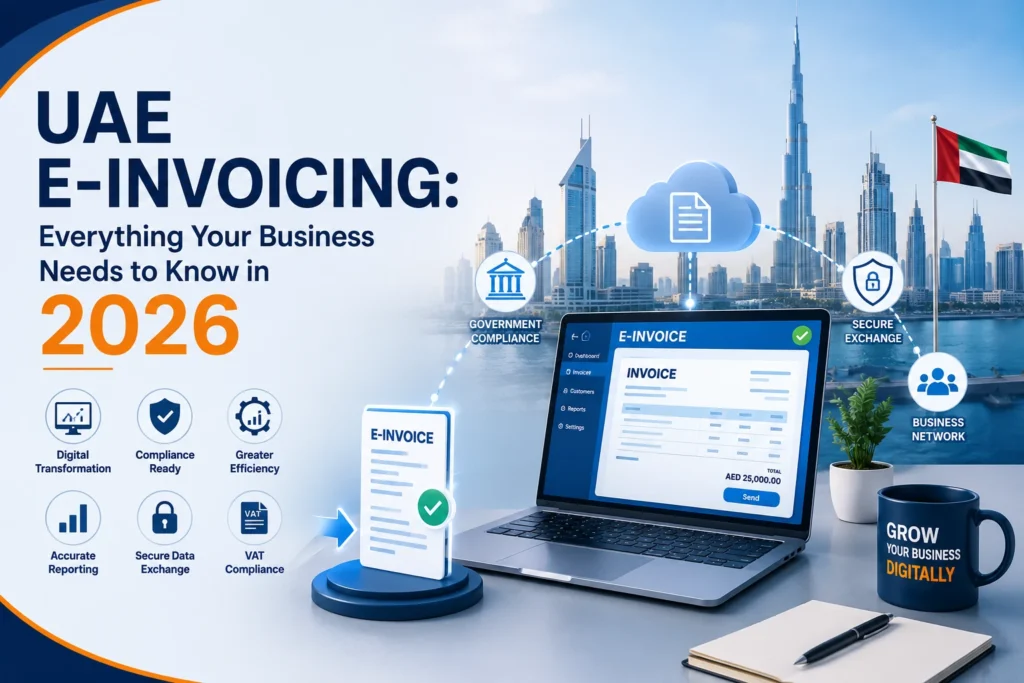
What Is UAE E-Invoicing?
UAE E-Invoicing is the electronic creation, exchange, validation, and storage of invoices using a structured digital format.
Unlike a PDF invoice attached to an email, an electronic invoice contains machine-readable data that accounting systems can automatically process without manual data entry.
A structured e-invoice can include information such as:
- Supplier details
- Customer information
- Tax details
- Product and service information
- Invoice totals
- Payment information
Because the data is standardized, businesses can exchange invoices more efficiently while reducing errors and improving financial accuracy.
PDF Invoice vs UAE E-Invoice
One of the biggest misconceptions is that emailing a PDF invoice is the same as e-invoicing.
It is not.
PDF Invoice | UAE E-Invoice |
Human-readable | Machine-readable |
Manual processing | Automated processing |
Email attachment | Structured digital exchange |
Higher chance of errors | Reduced manual errors |
Limited automation | Full automation possible |
Simply generating invoices in PDF format will not satisfy the structured data requirements of the UAE’s electronic invoicing framework.
Why Is the UAE Introducing E-Invoicing?
The UAE Government is introducing UAE E-Invoicing as part of its broader digital transformation strategy.
The initiative aims to create a secure and standardized invoicing ecosystem that benefits businesses, customers, and government authorities alike.
Key objectives include:
- Improving tax transparency
- Supporting digital transformation
- Reducing invoice fraud
- Enhancing VAT compliance
- Simplifying audits
- Increasing business efficiency
- Encouraging automation
For businesses, this means less manual work and more streamlined financial operations.
How Will UAE E-Invoicing Work?
The UAE plans to implement a decentralized model based on the internationally recognized Peppol framework.
Instead of invoices being exchanged directly between businesses, they will pass through Accredited Service Providers (ASPs) approved under the Ministry of Finance’s framework.
The simplified process looks like this:
- A business creates an invoice using its accounting or ERP system.
- The invoice is converted into the required structured electronic format.
- The invoice is securely transmitted through an Accredited Service Provider.
- The recipient receives the invoice electronically.
- Both businesses retain digital records for compliance and auditing purposes.
This model allows businesses using different accounting systems to exchange invoices securely and consistently.
What Is an Accredited Service Provider (ASP)?
An Accredited Service Provider (ASP) is an organization approved under the UAE’s e-invoicing framework to facilitate the secure exchange of electronic invoices.
Rather than every business connecting directly with every customer or supplier, ASPs act as trusted intermediaries, helping ensure that invoices meet technical standards and are transmitted securely.
It is important to note that an ASP is not the same as accounting software. Businesses may continue using their preferred accounting or ERP solution while connecting to the e-invoicing ecosystem through an accredited provider, depending on the final implementation model.
Who Will Be Affected?
The framework is expected to apply primarily to:
- Business-to-Business (B2B) transactions
- Business-to-Government (B2G) transactions
As implementation progresses, businesses of all sizes—including retailers, manufacturers, distributors, service providers, and SMEs—should assess whether their current accounting systems are ready to support structured electronic invoicing.
Benefits of UAE E-Invoicing
Preparing for UAE E-Invoicing is not only about compliance—it can also improve the way your business operates.
Faster Invoice Processing
Digital invoices can be exchanged and processed more quickly, reducing administrative delays.
Reduced Manual Errors
Structured invoice data minimizes the risk of incorrect entries and duplicate processing.
Better Financial Accuracy
Automation helps improve the accuracy of accounting records and reporting.
Improved Cash Flow
Faster invoice processing can contribute to quicker payment cycles.
Enhanced Business Efficiency
Employees spend less time on repetitive data entry and more time on value-added tasks.
Stronger Compliance
Maintaining structured digital records simplifies audits and supports regulatory reporting.
How Can Businesses Prepare?
Although implementation will be phased, businesses should begin planning now.
Consider the following steps:
Review Existing Invoicing Processes
Understand how invoices are currently created, approved, and shared.
Evaluate Your Accounting Software
Confirm whether your accounting or ERP system can support structured electronic invoicing or future integrations.
Clean Your Master Data
Ensure customer, supplier, VAT, and product information is accurate and consistent.
Train Your Finance Team
Introduce your accounting staff to digital invoicing concepts and upcoming regulatory changes.
Stay Updated
Follow announcements from the UAE Ministry of Finance and other official authorities regarding implementation phases and technical requirements.
How TallyPrime Can Support Your Business
Modern accounting software plays an important role in helping businesses prepare for digital transformation.
TallyPrime enables businesses to:
- Manage accounting efficiently
- Generate professional invoices
- Maintain VAT records
- Track inventory
- Produce financial reports
- Improve data accuracy
- Simplify business management
As the UAE’s e-invoicing ecosystem evolves, businesses using modern accounting software are generally better positioned to adapt to new digital requirements.
Common Misconceptions About UAE E-Invoicing
“We already send PDF invoices.”
PDF invoices are digital documents but are generally not considered structured e-invoices.
“Only large companies need to prepare.”
Businesses of all sizes should monitor the rollout and assess their readiness.
“We need to replace our accounting software immediately.”
Not necessarily. Many businesses may be able to continue using their existing accounting software while integrating with approved service providers, depending on the final implementation requirements.