

How to Prepare Your Business for UAE E-Invoicing: A Practical Checklist
Is Your Business Ready for UAE E-Invoicing?
The UAE is steadily progressing toward a modern UAE E-Invoicing framework as part of its digital transformation strategy. Although implementation will be introduced in phases, businesses that prepare early will have more time to adapt their accounting processes, train employees, and evaluate their software systems.
Whether you’re a startup, SME, or large enterprise, understanding how to prepare for UAE E-Invoicing can help reduce future compliance challenges while improving your overall business efficiency.
This guide outlines the practical steps every UAE business should consider before the e-invoicing framework becomes applicable.
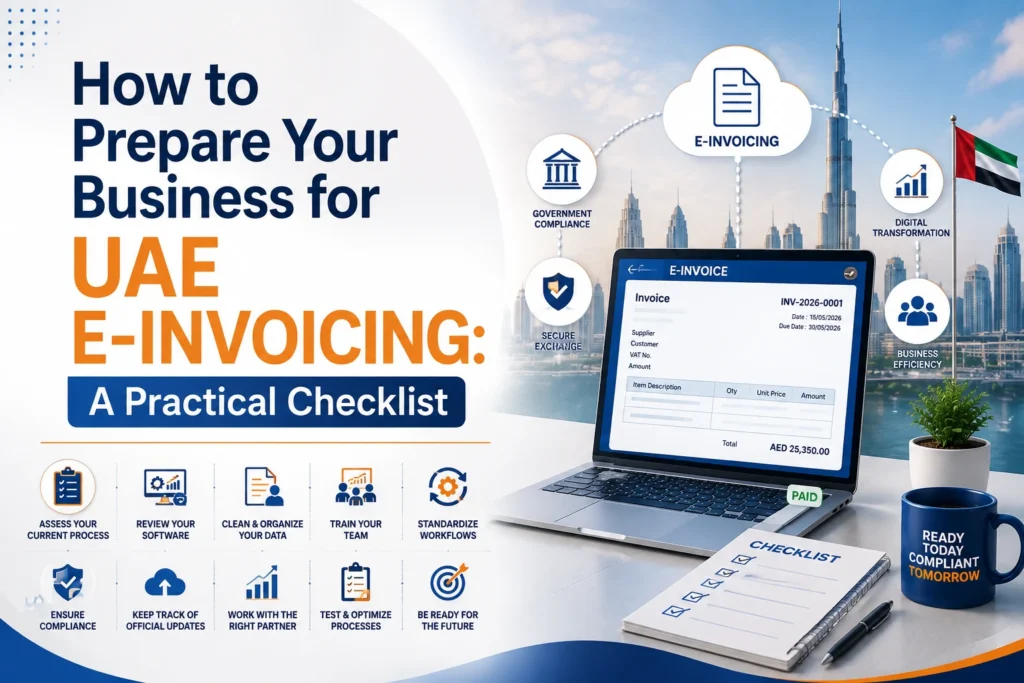
Why Should Businesses Prepare Now?
Many businesses assume they can wait until implementation becomes mandatory. However, upgrading systems and changing invoicing processes often requires planning and testing.
Preparing early allows your business to:
- Minimize operational disruption
- Improve invoice accuracy
- Train employees gradually
- Upgrade software without urgency
- Reduce manual work
- Improve financial reporting
- Stay ready for future regulatory requirements
Rather than seeing UAE E-Invoicing only as a compliance requirement, businesses can view it as an opportunity to modernize their financial operations.
Why Is the UAE Introducing E-Invoicing?
The UAE Government is introducing UAE E-Invoicing as part of its broader digital transformation strategy.
The initiative aims to create a secure and standardized invoicing ecosystem that benefits businesses, customers, and government authorities alike.
Key objectives include:
- Improving tax transparency
- Supporting digital transformation
- Reducing invoice fraud
- Enhancing VAT compliance
- Simplifying audits
- Increasing business efficiency
- Encouraging automation
For businesses, this means less manual work and more streamlined financial operations.
Step 1: Understand What UAE E-Invoicing Means
Before making any changes, it’s important to understand what UAE E-Invoicing actually is.
An electronic invoice is not simply a PDF sent by email. It is a structured digital document that can be automatically exchanged and processed between business systems.
Understanding this distinction helps businesses evaluate whether their current invoicing methods will support future requirements.
Step 2: Review Your Current Invoicing Process
Ask yourself:
- How are invoices currently created?
- Are invoices generated manually?
- Do different departments follow different invoice formats?
- Are invoices stored digitally?
- Is invoice approval automated?
Documenting your existing workflow will help identify areas that need improvement.
Step 3: Evaluate Your Accounting or ERP Software
One of the most important preparation steps is assessing whether your accounting software can support future digital invoicing requirements.
When reviewing your software, consider whether it can:
- Generate professional invoices
- Maintain accurate customer information
- Handle VAT calculations
- Generate financial reports
- Support software updates
- Integrate with future digital services if required
Modern accounting solutions such as TallyPrime help businesses simplify accounting, inventory management, and invoicing while improving operational efficiency.
Step 4: Organize Customer and Supplier Data
Accurate master data is essential for successful digital invoicing.
Review your records to ensure they contain:
- Business names
- VAT registration details (where applicable)
- Contact information
- Billing addresses
- Payment terms
- Product and service details
Keeping information updated reduces invoice errors and improves business communication.
Step 5: Standardize Invoice Formats
Many organizations use different invoice templates across departments.
Now is a good time to:
- Standardize invoice layouts
- Review invoice numbering
- Ensure consistent tax information
- Remove duplicate templates
- Improve document quality
A consistent invoicing process simplifies internal controls and customer communication.
Step 6: Train Your Finance Team
Technology alone is not enough.
Employees should understand:
- Digital invoicing concepts
- Updated business workflows
- Internal approval processes
- Record management
- Best practices for financial documentation
Providing training early makes adoption much smoother.
Step 7: Review Internal Business Processes
E-Invoicing affects more than the finance department.
Consider reviewing:
- Sales
- Purchasing
- Inventory
- Customer service
- Accounts receivable
- Accounts payable
A connected workflow improves efficiency across the entire organization.
Step 8: Monitor Official UAE Updates
The UAE Ministry of Finance continues to publish information about the country’s e-invoicing initiative.
Businesses should regularly monitor official announcements regarding:
- Implementation phases
- Technical requirements
- Accredited Service Providers (ASPs)
- Compliance guidance
- Business obligations
Staying informed helps businesses prepare at the right time.
Step 9: Work with the Right Technology Partner
Preparing for digital transformation is easier with experienced guidance.
A trusted implementation partner can help businesses:
- Assess current systems
- Review accounting processes
- Recommend suitable software
- Plan upgrades
- Provide implementation support
- Train employees
Choosing the right technology partner can reduce implementation risks and improve long-term efficiency.
Step 10: Create an Internal Readiness Plan
Instead of waiting for mandatory implementation, create an action plan.
Include:
- Review current invoicing
- Evaluate accounting software
- Clean customer database
- Update supplier records
- Standardize invoices
- Train finance staff
- Review internal workflows
- Follow official announcements
- Schedule software upgrades
- Test new processes
Having a roadmap allows your business to transition smoothly when required.
How TallyPrime Can Support Your Business
Businesses already using modern accounting software often find it easier to adapt to evolving business requirements.
TallyPrime offers features that help organizations:
- Manage accounting efficiently
- Generate professional invoices
- Maintain VAT records
- Track inventory
- Generate financial reports
- Improve business visibility
- Reduce manual work
While businesses should always follow official UAE guidance regarding e-invoicing implementation, investing in modern accounting software today can strengthen operational readiness.
Common Mistakes to Avoid
Many businesses delay preparation until the last moment.
Avoid these common mistakes:
- Waiting for the final implementation phase
- Using inconsistent invoice templates
- Maintaining inaccurate customer records
- Ignoring software updates
- Failing to train employees
- Not reviewing existing accounting processes
Early planning makes future implementation significantly easier.
Frequently Asked Questions
Is UAE E-Invoicing mandatory today?
Is a PDF invoice considered an e-invoice?
Do small businesses need to prepare?
Can accounting software help with UAE E-Invoicing?
What is an Accredited Service Provider (ASP)?
Final Thoughts
Preparing for UAE E-Invoicing is not just about meeting future compliance requirements—it’s an opportunity to improve business efficiency, streamline invoicing, and strengthen financial management.
Businesses that begin reviewing their systems, standardizing processes, and upgrading their accounting software today will be better positioned for a smooth transition as the UAE’s e-invoicing framework continues to roll out.
If your organization is evaluating its accounting systems or planning for digital transformation, working with an experienced implementation partner can help you assess your readiness and prepare with confidence.